


Nvidia has become one of the most closely watched companies in the technology sector, largely because its graphics processing units (GPUs) have become essential infrastructure for artificial intelligence. From training advanced AI models to powering cloud computing, gaming, robotics, and data centers, Nvidia’s technology sits at the center of several major digital trends. This broad exposure has made nvidia stocks an important subject for investors who want to understand the future of artificial intelligence and semiconductor markets.
The company is best known for designing high-performance chips and developing the software ecosystem that allows those chips to perform complex workloads efficiently. Its CUDA platform, networking products, data-center technologies, and increasingly broad AI computing portfolio have helped create an ecosystem that goes beyond selling individual processors.
For investors, however, a strong business does not automatically mean a stock is always attractive at every price. Understanding revenue growth, profitability, competition, valuation, industry cycles, and potential risks is essential before making an investment decision.
Why Nvidia Has Become an AI Powerhouse
Nvidia originally built its reputation around graphics processing for personal computers and gaming. GPUs were particularly effective at performing many calculations simultaneously, making them useful for rendering images and eventually for machine learning.
As artificial intelligence developed, the same architecture became valuable for training neural networks and running AI applications. This created a major opportunity for Nvidia. Its chips can process enormous amounts of data in parallel, while its software tools help developers use that computing power efficiently.
The company’s position has strengthened as businesses increasingly invest in generative AI, large language models, recommendation systems, autonomous machines, and other computationally demanding applications. Cloud providers and technology companies also require large quantities of accelerated computing hardware to build and operate AI infrastructure.
This shift is one of the central reasons nvidia stocks have attracted attention from both individual investors and large institutions.
How Nvidia Makes Money
Nvidia’s business is more diversified than its public image as a GPU company might suggest. Its operations span several important technology markets, with data-center computing becoming particularly significant.
| Business Area | Main Role | Why It Matters |
|---|---|---|
| Data Center | AI accelerators, networking and computing platforms | Supports AI training and inference |
| Gaming | Graphics processors and related technologies | Remains an important consumer market |
| Professional Visualization | Hardware and software for professional workloads | Serves designers, engineers and creators |
| Automotive | Computing platforms for vehicles and robotics | Provides exposure to autonomous technology |
| Software | AI development and computing tools | Strengthens the broader Nvidia ecosystem |
The data-center business is especially important because modern AI systems require substantial computing capacity. Nvidia also sells networking technologies and complete computing platforms, allowing it to participate in more parts of the AI infrastructure stack.
This ecosystem can create a competitive advantage because customers may consider hardware, networking, software, and developer tools together rather than purchasing a standalone chip.
The Role of GPUs in Artificial Intelligence
A major reason investors study nvidia stocks is the company’s relationship with accelerated computing.
Traditional central processing units are designed to handle a wide variety of tasks, while GPUs can perform many similar mathematical operations simultaneously. This makes GPUs particularly suitable for machine learning workloads, where enormous numbers of calculations must be performed repeatedly.
AI development involves two broad computing stages: training and inference. Training teaches a model using large amounts of data, while inference allows the trained model to generate predictions or responses.
Both stages can require substantial computing resources. As companies add AI capabilities to search engines, office software, customer-service systems, scientific research, cybersecurity tools, and other products, demand for specialized computing can increase.
However, AI demand is not guaranteed to grow at the same pace forever. Investors need to consider whether spending on AI infrastructure will remain strong, normalize, or move through periods of expansion and consolidation.
What Can Drive Nvidia’s Future Growth
Several factors could influence the company’s long-term performance. Continued investment in artificial intelligence is the most obvious driver, but it is not the only one.
First, businesses are still exploring ways to integrate AI into existing operations. This could increase demand for computing infrastructure as organizations move from experimentation toward larger deployments.
Second, cloud providers continue to build data centers capable of supporting advanced AI workloads. These facilities require accelerators, networking equipment, memory, storage, cooling, and power infrastructure.
Third, Nvidia is expanding beyond individual chips. Its integrated systems and networking products could allow it to capture more value from each AI computing installation.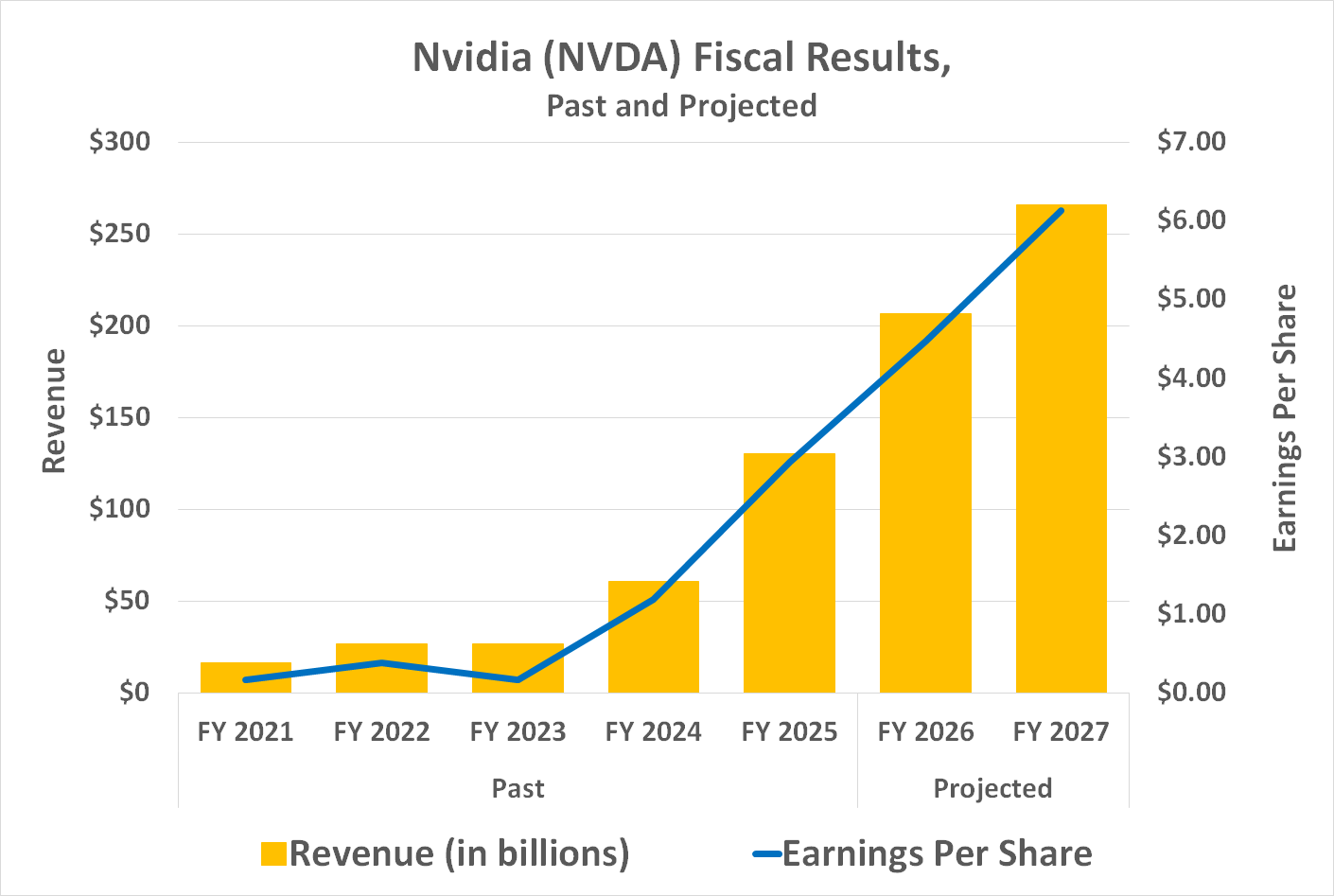
Fourth, emerging applications such as robotics, autonomous machines, digital twins, and scientific computing could provide additional markets.
These opportunities explain why nvidia stocks are often viewed as a long-term AI investment rather than simply a traditional semiconductor holding.
Important Financial Factors Investors Should Watch
A company’s technology leadership is only one part of an investment analysis. Investors should also examine financial performance and operating trends.
Revenue growth can show whether demand for Nvidia’s products is expanding, but the quality and sustainability of that growth are equally important. Strong sales accompanied by healthy profitability can indicate operating strength, while rapidly rising expenses or declining margins may change the picture.
Cash flow is another useful measure. A company generating substantial cash from operations has greater flexibility to invest in research, expand infrastructure, make strategic acquisitions, or return capital to shareholders.
Investors should also monitor research and development spending. Semiconductor leadership requires continuous innovation because competitors are constantly developing faster and more efficient products.
When evaluating nvidia stocks, investors should therefore consider several indicators together rather than focusing on one quarterly result.
Valuation Matters Even When the Business Is Excellent
One of the most important lessons for stock investors is that a great company can still become an expensive investment.
The market price reflects expectations about future earnings and cash flows. If investors already expect exceptionally strong growth, the company may need to exceed those expectations to produce attractive returns.
Valuation can be assessed using measures such as the price-to-earnings ratio, price-to-sales ratio, free-cash-flow yield, and expected earnings growth. None of these measures should be considered in isolation.
For example, a high valuation may be reasonable if a company’s earnings are expected to grow rapidly for many years. Conversely, a lower valuation may not necessarily represent an opportunity if growth prospects are deteriorating.
This is why investors should compare the company’s valuation with its expected growth, profitability, competitive position, and broader semiconductor conditions.
Competition and Industry Risks
Nvidia operates in a highly competitive industry. Other semiconductor companies are developing AI accelerators, while major cloud providers are also designing their own specialized chips.
Customers may eventually seek more alternatives to reduce dependence on a single supplier. Custom silicon could become increasingly important for companies with large-scale computing requirements.
Another risk comes from the semiconductor industry’s cyclical nature. Technology hardware markets can experience periods of intense demand followed by inventory corrections. Companies can also face manufacturing constraints, supply-chain disruptions, export restrictions, or changes in customer spending.
Rapid technological change creates another challenge. Today’s leading architecture can eventually be replaced by a newer approach. Nvidia must therefore continue investing heavily in engineering and software development.
For anyone considering nvidia stocks, these risks are just as important as the company’s growth opportunities.
What Investors Should Consider Before Buying
Investors should first determine their investment objective and time horizon. A long-term investor may focus on AI adoption, competitive advantages, earnings potential, and cash generation, while a short-term trader may be more concerned with market sentiment and price volatility.
A practical evaluation can include:
- Reviewing recent financial statements and earnings trends.
- Comparing valuation with expected growth.
- Monitoring developments in AI infrastructure and semiconductor demand.
- Assessing competitive threats and customer concentration.
- Considering how much portfolio exposure is appropriate for one technology company.
Diversification is also important. Even a market-leading company can experience sharp price declines because of changing expectations, economic conditions, or industry developments.
Investors should avoid making decisions based solely on headlines about AI or short-term share-price movements.
Nvidia’s Broader Technology Ecosystem
One feature that differentiates Nvidia from many semiconductor businesses is the depth of its ecosystem. Hardware performance is important, but software compatibility, developer familiarity, networking, libraries, and tools can also influence purchasing decisions.
Once companies build AI systems around a particular platform, changing technologies may require engineering work, testing, retraining, and additional costs. A strong ecosystem can therefore create switching barriers.
Nvidia’s software strategy is consequently an important part of the investment story. If the company continues to make its platform valuable to developers and enterprise customers, its competitive position could remain strong even as the hardware market evolves.
Long-Term Outlook for Nvidia
The long-term outlook for nvidia stocks depends heavily on whether AI becomes a sustained technology investment cycle rather than a temporary spending boom.
If companies continue deploying AI at scale, demand for accelerated computing could remain significant. Nvidia could benefit from expanding workloads, newer chip generations, networking products, and software services.
At the same time, investors should expect periods of uncertainty. Technology leadership does not eliminate valuation risk, competition, regulatory changes, supply limitations, or shifts in customer spending.
The most useful approach is therefore to separate the company’s business prospects from the stock’s current market price. A strong outlook for Nvidia’s operations does not automatically indicate that its shares are undervalued.
Conclusion
Nvidia’s transformation from a graphics-chip specialist into a major AI computing company has reshaped its position within the technology industry. Its GPUs, networking products, software ecosystem, and data-center platforms give it exposure to the expanding demand for artificial intelligence and accelerated computing.
For investors researching nvidia stocks, the key is to look beyond short-term price movements. Revenue growth, margins, cash flow, innovation, valuation, competition, and industry risks all deserve careful attention. Nvidia may continue to benefit from powerful technology trends, but successful investing requires balancing those opportunities against the expectations already reflected in the share price. Ultimately, Nvidia’s investment case rests on its ability to maintain technological leadership while turning AI demand into durable, profitable growth. Investors who understand both the opportunity and the risks can make more informed decisions based on their own financial goals, risk tolerance, and investment horizon.